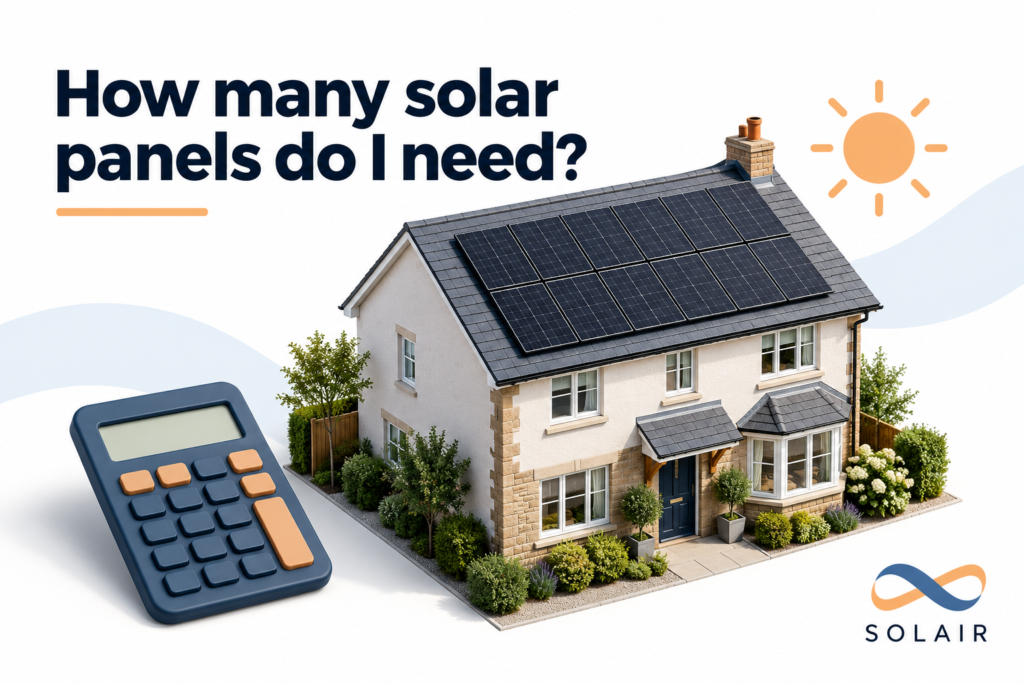
Most homes in the South East need between 6 and 12 solar panels. A typical three-bedroom house using about 2,500 to 3,500kWh of electricity a year usually suits 8 to 10 modern panels, which is a system of about 3.5 to 4.5kW. Homes with an electric car or a heat pump use far more electricity and often fit 12 to 16 panels or more, if the roof has space.
The right number for you depends on three things: how much electricity you use, how much roof you have, and which way it faces. Here is how to work it out.
Step 1: find your yearly electricity use
Your annual electricity use in kilowatt hours (kWh) is on your energy bill or in your supplier’s app. Look for “annual consumption” or add up the last 12 months.
If you do not have it to hand, these are Ofgem’s typical figures for a home on a standard electricity meter, updated from 1 July 2026:
| Household | Typical yearly use |
|---|---|
| Low use (often a flat or a one to two bedroom home) | 1,600kWh |
| Medium use (often a two to three bedroom home) | 2,500kWh |
| High use (often a four bedroom home or more) | 3,800kWh |
An electric car can add around 2,000kWh or more a year, depending on how far you drive. A heat pump can add several thousand more. If you are planning either, it is worth sizing your solar for the future rather than for today.
Step 2: how much one panel makes
Most panels fitted today are rated at around 430 to 450 watts. In the South East, each kilowatt of panels on a south-facing roof produces roughly 950kWh a year. So a single 440 watt panel makes about 420kWh a year on a good south roof.
Roof direction changes this a lot:
| Roof direction | Yearly output per kW of panels | Yearly output per 440W panel |
|---|---|---|
| South | about 950kWh | about 420kWh |
| South-east or south-west | about 900kWh | about 395kWh |
| East-west split | about 780kWh | about 345kWh |
| North | about 550kWh | about 240kWh |
London is slightly lower than this and coastal Sussex and Hampshire are slightly higher, but the difference is small.
Step 3: divide your use by what a panel makes
Divide your yearly electricity use by the output of one panel on your roof. That gives the number of panels needed to make roughly as much electricity in a year as you use.
On a south-facing roof with 440 watt panels:
| Yearly use | Panels to match your use | System size |
|---|---|---|
| 1,600kWh | 4 (most people fit at least 6) | about 1.8kW |
| 2,500kWh | 6 | about 2.6kW |
| 3,800kWh | 9 | about 4.0kW |
| 5,000kWh (with an electric car) | 12 | about 5.3kW |
| 7,000kWh (electric car and heat pump) | 17 | about 7.5kW |
On an east-west roof you need about 20% more panels for the same output. The upside is that east-west panels spread generation across the morning and evening, when many households are using more power.
Should you match your use exactly?
Not necessarily. Matching your yearly use is a good starting point, but two things change the picture.
You will not use all of it yourself. Solar panels make most of their electricity in the middle of the day and in summer. Without a battery, a typical home only uses around a third to a half of what its panels make. The rest goes to the grid. A home battery lets you store the daytime surplus and use it in the evening.
Panels are cheaper per kW in larger numbers. Scaffolding, the inverter and labour are a big part of the cost whatever the size. Adding two or three more panels while the scaffolding is up usually costs much less than adding them later. If you have the roof space and expect your electricity use to grow, it often pays to go a little bigger.
But exports only pay with the right paperwork. Payments for the electricity you send to the grid come through the Smart Export Guarantee, which needs an MCS-certified installation. If you will not be receiving export payments, it usually makes more sense to size for what you can use yourself, or to add a battery, rather than to make lots of surplus. Our guide to whether solar panels are worth it works through the numbers both ways.
Step 4: check your roof space
A 440 watt panel is roughly 1.7m by 1.1m, so each panel needs about 2m² of roof, plus a small margin around the edges.
| Panels | Roof area needed (roughly) |
|---|---|
| 6 | 12 to 14m² |
| 8 | 16 to 18m² |
| 10 | 20 to 23m² |
| 12 | 24 to 27m² |
| 16 | 32 to 36m² |
Chimneys, roof windows, vents and valleys all reduce the usable space, and hip roofs and dormers can be awkward shapes. Shading from trees, chimneys or neighbouring buildings matters too, because even partial shade on one panel can reduce the output of others in the same string, unless the system uses optimisers or microinverters.
If your main south-facing roof is small, using both sides of an east-west roof, or a garage or extension roof, can make up the difference.
Step 5: the grid connection limit
Every home solar system has to be registered with your local electricity network operator (the DNO), and your installer handles this.
For most homes with a single-phase supply, an inverter up to 3.68kW can be connected with a simple notification after installation, under a standard called G98. Above that, your installer must apply for approval before fitting the system, under G99. Approval is usually free for homes but can take several weeks, and the network operator can limit how much you export.
You can still fit more than 3.68kW of panels on a 3.68kW inverter. A 4kW to 4.5kW array on a 3.68kW inverter is common, because panels rarely produce their full rated power in the UK. The inverter simply clips the rare peaks.
A quick guide by home
| Home | Typical number of 440W panels |
|---|---|
| One to two bedroom flat or house | 4 to 8 |
| Three bedroom house | 8 to 10 |
| Four bedroom house | 10 to 14 |
| Any home with an electric car or heat pump | 12 to 16 or more |
These are starting points for a south-facing roof with little shade. A survey looks at your actual roof, usage and plans.
What does it cost?
Solar costs are usually quoted per kilowatt. The Energy Saving Trust puts a typical 4.5kW system at about £7,600, and installations of solar panels in homes are zero-rated for VAT until 31 March 2027. Our guide to whether solar panels are worth it covers costs, savings and payback for homes in Surrey, Sussex, Hampshire and London.
Frequently asked questions
How many solar panels do I need for a 3 bedroom house?
Usually 8 to 10 panels of around 440 watts, giving a system of about 3.5 to 4.5kW. That makes roughly 3,300 to 4,300kWh a year on a south-facing roof in the South East, which covers what most three-bedroom homes use in a year.
How many solar panels do I need to run a house off grid?
Going fully off grid in the UK is not realistic for most homes. Panels make about four times as much in May as in December, so a system big enough for winter would need a very large roof and battery. Most homes stay connected to the grid and use solar to cut their bills.
How many solar panels do I need to charge an electric car?
An average car covering about 7,500 miles a year uses around 2,000kWh. That is roughly 5 extra panels on a south roof. Most charging happens in the evening, so a battery or a smart charger that tops up when the sun is out helps you use more of your own solar.
Is 4kW of solar enough?
For most three-bedroom homes, yes. A 4kW system on a south-facing roof in the South East makes about 3,800kWh a year, close to a typical high-use household’s yearly electricity use.
Can I add more panels later?
You can, but it usually costs more per panel because the scaffolding, labour and possibly a new inverter or grid application are needed again. If you think your use will grow, it is cheaper to plan for it at the start.
Want a number for your own roof? Try our solar savings calculator, read more about solar panels with Solair and solar with battery storage, or request a free survey for a fixed, written price. We cover homes across Surrey, Sussex, Hampshire and London.