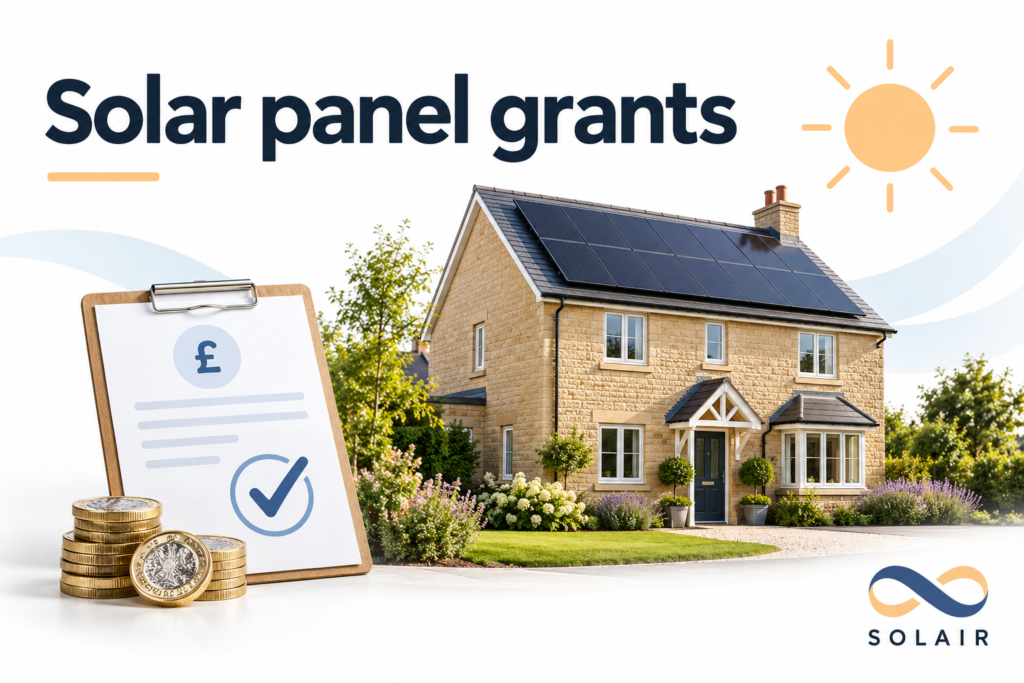
There is help with the cost of solar panels in England in 2026, but most of it is not a free grant. Every household gets 0% VAT on solar panels and batteries until 31 March 2027. Households with an MCS-certified installation can also be paid for the electricity they export through the Smart Export Guarantee, and a new government-backed loan scheme is starting to make borrowing cheaper. Free or heavily funded panels are mainly for lower-income households in homes with poor energy ratings.
If you are a homeowner on an average or higher income, the honest answer is that you will probably pay full price for your panels. The good news is that solar can still pay for itself. Below we explain each scheme, who qualifies and where to apply.
The short answer: what is available in 2026
| Scheme | What you get | Who can get it | Status (October 2026) |
|---|---|---|---|
| 0% VAT on energy-saving materials | No VAT on installed solar panels and batteries | Every household in Great Britain | Runs until 31 March 2027 |
| Smart Export Guarantee (SEG) | Payment for electricity you send to the grid | Homes with an MCS-certified installation and a suitable smart meter | Open, rates set by each supplier |
| Warm Homes: Local Grant | Funded upgrades, which can include solar panels | Mainly lower-income homeowners and private tenants in homes rated EPC D to G | Running through councils until March 2028 |
| Warm Homes Loan Scheme | Lower interest on loans for solar, batteries and heat pumps | Owner-occupiers and private landlords, with no income test | Consumer launch phase began in September 2026 |
| ECO4 | Funded energy upgrades through energy suppliers | Mainly households on certain benefits or low incomes | Ends on 31 December 2026, with no successor scheme |
| Solar Together group buying | A discounted group price, not a grant | Residents of taking-part council areas | Runs in rounds, so check your council |
0% VAT on solar panels and batteries
This is the one form of help that every homeowner gets. Since 1 May 2023, the installation of solar panels in homes in Great Britain has been charged at 0% VAT instead of 5%. Batteries were added from 1 February 2024, including batteries fitted to an existing solar system or on their own.
HMRC guidance says the 0% rate runs until 31 March 2027. From 1 April 2027 it is due to go back to the reduced rate of 5%. On a £7,500 system that would add about £375 to the bill.
You do not need to apply for this. A VAT-registered installer simply does not charge VAT on a qualifying installation. The relief applies to panels and batteries that are supplied and installed together, so buying kit to fit yourself does not count.
The Smart Export Guarantee (SEG)
The SEG is not a grant, but it is the main ongoing payment for solar in England. Larger electricity suppliers must offer a tariff that pays you for the electricity your panels send to the grid. Ofgem’s rules say the rate must always be above zero, but each supplier sets its own price.
In practice, rates in autumn 2026 vary a lot:
- The lowest SEG tariffs pay as little as 2p to 4p per kWh.
- Many big suppliers pay around 12p per kWh if you also buy your electricity from them.
- A few pay 15p or more, again usually only to their own customers.
To get SEG payments you need two things. First, a smart meter that records the electricity you export. Second, your system must be installed by an MCS-certified installer using MCS-certified products. Your supplier will usually ask for the MCS certificate when you sign up. Without that certificate, most suppliers will not pay you for exports, so it is worth checking an installer’s certification before you sign anything if export income matters to you.
The SEG has no closing date, and you can switch to a better tariff later.
The Warm Homes Plan and Warm Homes: Local Grant
The government published its Warm Homes Plan in January 2026. It sets out £15 billion over this Parliament to upgrade up to 5 million homes by 2030, and it names solar panels and batteries alongside insulation and heat pumps. More than £5 billion of that is for grants to lower-income households.
For homeowners, the main grant today is the Warm Homes: Local Grant. It is run by local councils in England and can pay for insulation, heat pumps, smart controls and solar panels. Government figures from July 2026 show that solar panels were the most common upgrade fitted under the scheme so far, at 38% of all measures. The scheme runs from April 2025 to March 2028.
To qualify, according to GOV.UK, your home must:
- be in England,
- be privately owned, either by you or your landlord,
- have an Energy Performance Certificate (EPC) rating of D, E, F or G.
Your household income must usually be £36,000 a year or less. You may still qualify above that level if you live in certain lower-income postcode areas or someone in your home gets certain means-tested benefits.
You can check your eligibility and apply through the Warm Homes: Local Grant service on GOV.UK. Your council, or a group of councils working together, decides which homes get which upgrades and arranges the installers, so you cannot pick any installer you like.
The Warm Homes Plan says these low-income grants will be brought together into a single scheme from 2027/28. Details were still emerging at the time of writing.
The Warm Homes Loan Scheme
This is the newest form of help, and it is the one most likely to matter to homeowners who do not qualify for a grant. It is a loan, not a grant.
Under the scheme, the government pays participating lenders to cut the interest rate on green home loans by up to 5 percentage points. The scheme rules published in September 2026 say:
- owner-occupiers and private landlords across the UK can apply, with no income test,
- solar panels and batteries can each be funded up to £15,000, and heat pumps have their own limits,
- the work must be done by an installer with the right certification, which for solar means MCS,
- you apply directly to a participating lender, not to the government.
The scheme’s initial consumer launch phase began in September 2026. At the time of writing, no list of participating lenders had been published, so we cannot tell you the rates on offer. If you are thinking of borrowing for solar, it is worth asking your bank or building society whether they are taking part.
ECO4 is ending
ECO4 (the Energy Company Obligation) made the big energy suppliers fund upgrades for lower-income households. It mainly paid for insulation and heating, and only occasionally included solar panels.
ECO4 was due to close on 31 March 2026, but the government extended it to 31 December 2026. Its sister scheme, the Great British Insulation Scheme, closed as planned on 31 March 2026. The government has confirmed there will be no successor supplier scheme. Instead, it is putting an extra £1.5 billion of grant funding into upgrades for low-income households through the Warm Homes Plan.
If you are on certain benefits or a low income and want to try ECO4 before it closes, you would need to move quickly. Funding is limited and installers are already winding down their work.
The Home Upgrade Grant has closed
You may still see the Home Upgrade Grant mentioned online. Phase 2 of that scheme closed to councils in January 2023 and its funding ran until March 2025. The Warm Homes: Local Grant has taken over the same role of helping lower-income homes that are not on mains gas or have poor energy ratings.
Great British Energy and other government solar schemes
Great British Energy, the government’s publicly owned energy company, is funding solar panels on schools, hospitals and other public buildings. It does not offer grants to homeowners.
In April 2026 the government also announced that plug-in balcony solar panels should be available in shops within months, that new homes in England will have solar panels as standard, and that extra money would go to solar on social housing. None of these is a grant for an existing privately owned home.
Be cautious of websites offering “free government solar panels” to anyone. The genuine free schemes are means-tested and run through councils or, until the end of 2026, energy suppliers.
Council group-buying schemes: Solar Together
Solar Together is a group-buying scheme that many councils run with a company called iChoosr. Residents register their interest for free, approved installers bid in an auction, and everyone who registered gets a quote at the winning price. There is no obligation to go ahead.
It is not a grant. You still pay for your system, and the saving comes from the bulk price. It also runs in rounds, so it is not always open.
Here is what we could find for our area:
- Surrey: Surrey County Council ran a Solar Together round in summer 2025, with registration from June to August 2025 and installs due to finish by March 2026. Several Surrey borough councils promoted it.
- Sussex: East Sussex County Council says Solar Together Sussex is currently closed to new applicants but expects a new round in future.
- Hampshire: Hampshire has run Solar Together rounds in past years. We could not find an open round as of October 2026.
- London: Solar Together London ran in earlier years. We could not find an open London-wide round as of October 2026.
If you are interested, check your council’s website or the Solar Together site to see if a new round is planned.
Green mortgages and other loans
Some banks and building societies offer green mortgages or green further advances. These usually give a lower rate or cashback when a home has a good EPC rating, or when you borrow to make energy-saving improvements. Products change often and have their own conditions, so speak to your lender or a mortgage adviser.
Some councils have also offered low-interest home improvement loans in the past. Again, these vary by area, so it is worth checking with your own council.
What most homeowners actually pay
If your household income is above about £36,000 a year and your home already has a reasonable EPC rating, you are unlikely to qualify for a grant. That describes most homeowners in Surrey, Sussex, Hampshire and south west London.
For you, the help that counts is the 0% VAT rate, which is already built into the price, and income from exporting if your installation is MCS certified. A typical 4 to 5 kW system costs roughly £6,000 to £9,000 with no VAT.
That is still a worthwhile spend for many homes. In our worked example in the guide are solar panels worth it, a 4.8 kW system costing about £7,300 to £8,300 saves around £420 a year in electricity you no longer buy. Export income needs an MCS-certified installation; without it the same system saves about £420 a year. With it, the system also earns around £360 a year from exports at 12p per kWh. That is about £780 a year in total, which means it pays for itself in about 9 to 11 years. Adding a battery can raise how much of your own solar you use. Our guide to solar and battery systems explains when that makes sense.
Frequently asked questions
Can I get free solar panels in 2026?
Only if you meet the criteria for a means-tested scheme. In practice that means the Warm Homes: Local Grant through your council or, until 31 December 2026, ECO4 through an energy supplier. Most homeowners do not qualify and pay for their panels themselves.
Is there a government grant for solar batteries?
There is no general grant for batteries. Batteries do benefit from 0% VAT until 31 March 2027, even when added to an existing system. They can also be funded through the Warm Homes Loan Scheme, and they are included in the Warm Homes Plan’s low-income grants.
Will the 0% VAT rate be extended?
There has been no announcement of an extension. HMRC guidance says the rate goes back to 5% from 1 April 2027.
Do I need an MCS-certified installer?
You need one to get SEG export payments and to use the Warm Homes Loan Scheme. Grant schemes also set their own installer requirements. Always ask an installer which certifications they hold and what that means for your export payments before you go ahead.
Does Solar Together give you a grant?
No. It is a council-backed group-buying scheme that aims to get a good price through bulk buying. You still pay for the system yourself.
Getting a price for your home
Grants are worth checking first, especially if your income is under £36,000 or your home has a low EPC rating. If you do not qualify, a fixed price and an honest view of the savings is the next step. Solair covers Surrey, Sussex, Hampshire and south west London. You can find out more about our solar panels and solar and battery options, or request a free survey.