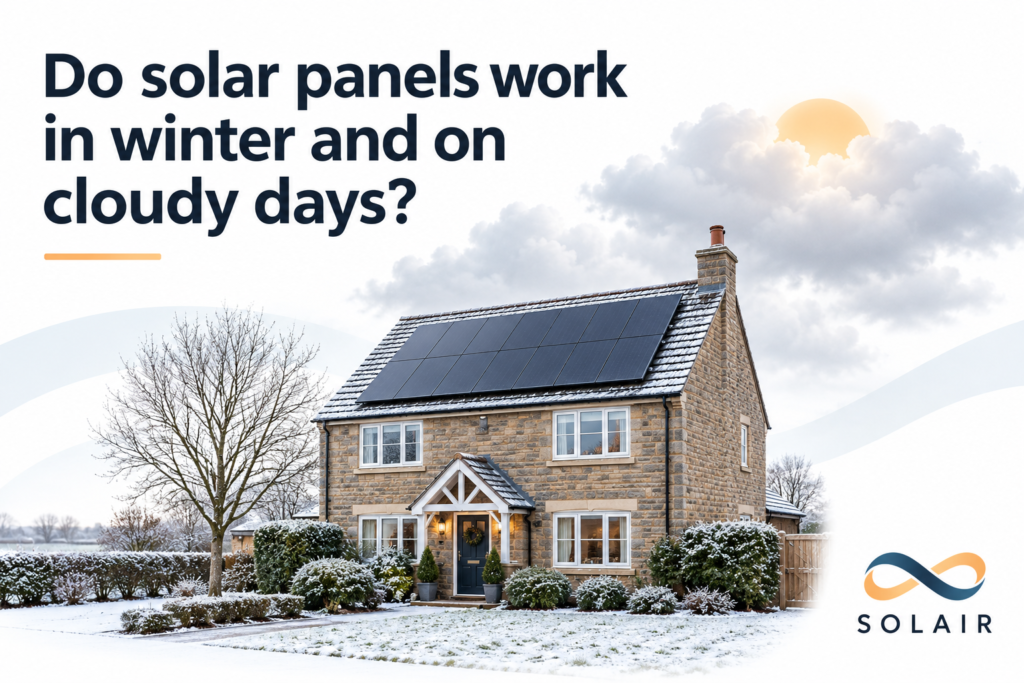
Yes, solar panels work in winter and on cloudy days, because they run on daylight rather than heat or direct sunshine. But they make a lot less. In the UK a solar system produces about a quarter as much electricity in December as it does in May or June, and about 70% of its yearly output comes between April and September.
That does not make solar a bad idea in the UK. It just means it is worth knowing what to expect, and planning your system around the whole year rather than a sunny day in July.
How much do solar panels make each month?
The figures below show the average electricity made by each kilowatt of panels on a south-facing roof in southern England, using the European Commission’s PVGIS solar data. We have also shown what a typical 4kW system (about 9 panels) would make.
| Month | Output per kW of panels | 4kW system | Per day, 4kW system |
|---|---|---|---|
| January | 33kWh | 132kWh | about 4kWh |
| February | 49kWh | 196kWh | about 7kWh |
| March | 82kWh | 328kWh | about 11kWh |
| April | 110kWh | 440kWh | about 15kWh |
| May | 119kWh | 476kWh | about 15kWh |
| June | 117kWh | 468kWh | about 16kWh |
| July | 117kWh | 468kWh | about 15kWh |
| August | 105kWh | 420kWh | about 14kWh |
| September | 87kWh | 348kWh | about 12kWh |
| October | 61kWh | 244kWh | about 8kWh |
| November | 40kWh | 160kWh | about 5kWh |
| December | 29kWh | 116kWh | about 4kWh |
| Year | about 950kWh | about 3,800kWh |
At the October to December 2026 price cap rate of 26.32p per kWh, the electricity from that 4kW system is worth about £125 in May and about £30 in December, if you use it all yourself.
A typical home uses around 7 to 9kWh a day in winter, so in December a 4kW system covers only part of your daytime use. In summer the same system makes more than most homes can use during the day.
Why do panels make less in winter?
Shorter days. In southern England there are about 16 hours of daylight in late June and fewer than 8 in late December.
A lower sun. In winter the sun stays low in the sky, so its light hits the panels at a shallower angle and travels through more atmosphere. Less energy reaches each square metre.
More cloud. Winter is greyer, and thick cloud cuts output sharply.
Longer shadows. A tree, chimney or neighbouring house that does not shade your roof in summer can shade it for much of a winter day, when the sun is low.
Do solar panels work on cloudy days?
Yes, but at a fraction of their full power. Panels use both direct sunlight and the diffuse daylight that comes through cloud. On a bright, hazy day output can still be good. Under thick, dark cloud it may fall to a small fraction of what the same panels make in full sun.
The good news is that the yearly figures above already include the UK’s cloudy weather. When you see an estimate of about 950kWh per kW a year for the South East, that is an average across real weather, not a cloudless ideal.
Does cold weather affect solar panels?
Cold actually helps. Solar panels become slightly more efficient as they get colder, and lose a little efficiency as they heat up. Their ratings are measured at a cell temperature of 25°C, and a typical panel loses roughly 0.3% to 0.4% of its output for each degree hotter than that.
On a hot July afternoon, panels on a roof can be well above 25°C, so they lose some power. On a cold, clear winter morning they run cool and work very efficiently. The shorter days still mean less electricity overall, but a crisp, bright winter day can produce surprisingly good figures.
What about snow and frost?
A light frost usually melts within an hour or so of the sun reaching the panels. A thin layer of snow may let some light through, and panels are smooth, dark and tilted, so snow tends to slide off as soon as they warm up a little.
Do not climb onto the roof or use hot water to clear snow. It is dangerous, and very hot water on cold glass can damage it. In the South East, snow rarely sits on panels for more than a day or two, and the electricity lost is very small over a year.
Is solar still worth it if winter output is low?
For most homes in the South East, yes. Solar is judged on what it makes across a whole year, and the summer months do most of the work. A system that pays its way over a year does not need to cover your winter bills.
What winter does change is how you think about the rest of your setup:
Battery storage works all year. In summer a battery stores your spare daytime solar for the evening. In winter, when there is little spare solar, many people charge the battery overnight on a cheaper off-peak tariff and use that electricity during the expensive daytime and evening hours. That keeps the battery earning its keep through the darker months. Our guide on what size battery you need explains how this works.
Size for the whole year. It is not worth adding extra panels just to cover December, because they would make far more than you need in summer. Our guide to how many solar panels you need explains how to size a system.
Look at your winter shading. A good survey checks where the shadows fall when the sun is low, not just in summer.
How to get the most from your panels in winter
- Use power in the middle of the day. Run the dishwasher, washing machine or tumble dryer between about 10am and 2pm on brighter days.
- Trim trees that cast shadows over the roof in winter, where you can.
- Check your app. Most inverters have an app showing what your panels make. A sudden drop on bright days can be an early sign of a fault.
- Use an off-peak tariff to charge a battery or an electric car overnight in winter.
- Leave the panels alone. UK rain keeps them reasonably clean, and winter dirt makes little difference.
Frequently asked questions
How much do solar panels produce in winter in the UK?
In December, each kilowatt of panels in southern England makes about 29kWh on average, or about 1kWh a day. A typical 4kW system makes about 4kWh a day in December, compared with about 15kWh a day in May and June.
Do solar panels work on cloudy days?
Yes. They use daylight, not just direct sunshine, so they keep working under cloud. Output is lower, especially under thick cloud, but the UK’s yearly estimates already include cloudy days.
Do solar panels work in the rain?
They keep working at a reduced level, because there is still daylight. Rain also washes dust and pollen off the glass, which helps over the year.
Do solar panels work at night?
No. Panels need daylight. At night your home uses grid electricity, or electricity stored in a battery.
Can solar panels heat my home in winter?
Not directly in a useful way, because winter output is low when heating demand is highest. Solar is best thought of as cutting your electricity bill across the year. If you are interested in efficient electric heating, see our guide to air conditioning vs heat pumps.
Want to see what your roof would make across the year? Try our solar savings calculator, read more about solar panels with Solair or solar with battery storage, or request a free survey for a fixed, written price. We cover homes across Surrey, Sussex, Hampshire and London.