If you have been looking at ways to heat or cool your home, you have probably noticed that the words “air conditioning” and “heat pump” get used in confusing ways. The short answer is that a modern reversible air conditioning system is a heat pump. It is called an air-to-air heat pump. What most people mean by “a heat pump” in the UK is something different, an air-to-water heat pump that runs your radiators and hot water.
Both take heat from the outside air and move it indoors. The difference is where that heat ends up.
Is air conditioning a heat pump?
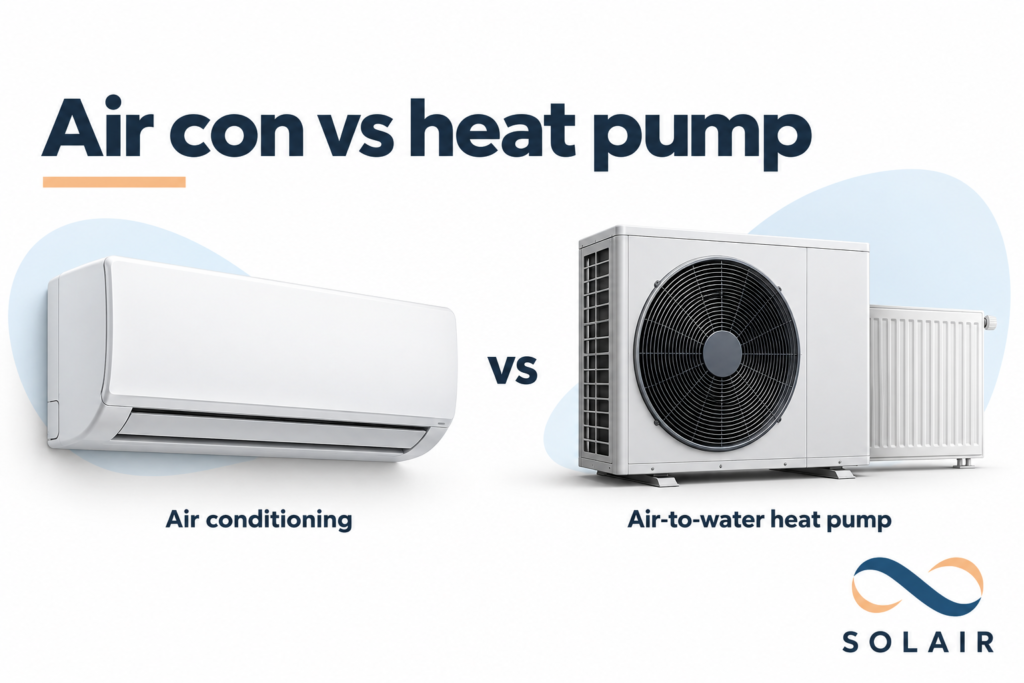
Most fixed air conditioning sold in the UK today is reversible. In winter it pulls heat from the outside air and pushes it into your room. In summer it runs the other way and moves heat out of the room.
A split system has an outdoor unit linked by refrigerant pipes to slim indoor units that blow warm or cool air into each room. You can read more on our air conditioning page.
An air-to-water heat pump also has an outdoor unit, but instead of blowing air into rooms it heats water. That water flows round your radiators or underfloor heating and also heats a hot water cylinder for your taps and showers. It is a direct replacement for a gas or oil boiler.
What does each one heat?
An air-to-air system heats the air in the rooms that have an indoor unit. If you fit units in the living room and two bedrooms, those three rooms are heated and cooled. Rooms without a unit, such as a hallway or bathroom, get little or no direct heat. Your radiators are not connected to it at all.
An air-to-water system heats the whole house through the radiators or underfloor heating you already have, or through new ones. Every room with a radiator is covered in the same way it is with a boiler.
What about hot water?
The Energy Saving Trust says that most air-to-air systems do not provide hot water, so you need another way of heating water for showers, baths and taps. In most homes that means keeping your boiler for hot water, or using an electric immersion heater or a separate hot water heat pump. Which? notes that some air-to-air systems can be linked to a hot water tank, but not all of them can.
An air-to-water heat pump is designed to provide hot water as well as heating. It usually needs a hot water cylinder, because a heat pump cannot heat water instantly the way a combi boiler does. The Energy Saving Trust says the cylinder usually needs a cupboard space of at least 80cm by 80cm. If you have a combi boiler and no cylinder today, finding room for one is part of the job.
Can a heat pump cool your home?
Air-to-air systems are built to cool as well as heat. That is one of their main attractions in rooms that overheat in summer, such as loft bedrooms, south-facing living rooms and home offices.
Which? points out that some air-to-water heat pumps can provide cooling, but not all of them can. Radiators are not designed to cool a room, so an air-to-water system is not a replacement for air conditioning.
How efficient are they?
Heat pumps move heat rather than make it. If one produces 3 units of heat for each unit of electricity, its efficiency is 3. Over a season this is the SCOP on a product label, or the SPF when measured in a real home.
For air-to-water heat pumps there is good UK data. The government-funded Electrification of Heat project monitored 742 heat pumps in real homes and found a median SPF of 2.80 for air source heat pumps. Even on the coldest days, with temperatures down to minus 6°C, the median was 2.44. The Energy Systems Catapult, which ran the project, described them as three times more efficient than gas boilers.
For air-to-air systems, the Energy Saving Trust says there is not yet much data on how they perform in UK homes. Every model has a SCOP on its energy label, so you can compare units. To qualify for the Boiler Upgrade Scheme grant, both types must reach a SCOP of at least 2.8.
Install cost compared
| Air-to-air (reversible air con) | Air-to-water heat pump | |
|---|---|---|
| What it heats | Rooms with an indoor unit | Whole house via radiators or underfloor heating |
| Hot water | Usually not | Yes, usually with a cylinder |
| Cooling | Yes | Only some models, and not via radiators |
| Typical installed cost | About £1,900 for one room, about £3,700 for a three-bed semi | About £12,000 before any grant |
| Boiler Upgrade Scheme grant | £2,500, if it replaces your heating | £7,500 (£9,000 for some off-gas homes until March 2027) |
| Planning in England | Usually permitted development since 29 May 2025 | Usually permitted development |
| Typical disruption | One to three days, small holes for pipes | Several days, may include new radiators and a cylinder |
The cost figures come from the Energy Saving Trust and Which?. Our guide to air conditioning costs breaks down what affects the price of an air-to-air system in more detail.
Running costs compared with a gas boiler
All heat pumps run on electricity, so the sums come down to the price of electricity, the price of gas and how efficient each system is.
Under the Ofgem price cap for October to December 2026, the average Direct Debit unit rate is 26.32p per kWh for electricity and 7.97p per kWh for gas. VAT has been removed from electricity bills from 1 October 2026 to 31 March 2027, while gas still carries 5% VAT. Those are the figures we use across our guides.
Here is roughly what one unit (kWh) of heat costs:
- A heat pump with an efficiency of 2.8 costs about 9.4p per kWh of heat (26.32p divided by 2.8).
- A heat pump with an efficiency of 3.5 costs about 7.5p per kWh of heat.
- A gas boiler at around 90% efficiency costs about 8.9p per kWh of heat (7.97p divided by 0.9).
So on a standard tariff, a heat pump running at the median efficiency from the UK trial costs about the same as gas, and a better-performing system is cheaper. The Energy Saving Trust makes a similar point. It says heat pumps may cost a little more to run than a new gas boiler on standard electricity rates, but a time-of-use tariff can cut running costs significantly.
Against direct electric heaters, which turn one unit of electricity into one unit of heat, any heat pump is far cheaper to run.
These figures leave out standing charges, and your own costs will depend on your tariff, insulation and how you use the system.
Grants: the Boiler Upgrade Scheme
The Boiler Upgrade Scheme in England and Wales currently offers:
- £7,500 towards an air-to-water (air source) heat pump.
- £7,500 towards a ground source heat pump.
- £2,500 towards an air-to-air heat pump, for applications from 28 April 2026.
Until March 2027, homes heated by oil or LPG without a mains gas connection can get an extra £1,500 towards an air-to-water or ground source heat pump. This extra amount does not apply to air-to-air systems.
The rules are strict for both types. The heat pump must replace an existing fossil fuel or electric heating system, such as a gas, oil or LPG boiler or electric heaters. It must be fitted by an MCS-certified installer. You cannot get a grant to replace an existing low-carbon system, and there is one grant per property. For an air-to-air system, Ofgem’s guidance says it must be able to meet 100% of the home’s space heating needs and is only available for homes, not businesses.
That means the grant does not apply if you are adding air conditioning to a few rooms and keeping your boiler. Solair does not offer installations under the Boiler Upgrade Scheme, so if you want to use the grant you will need an MCS-certified installer.
Planning permission
In England, both types are usually allowed under permitted development, which means you do not need to apply for planning permission.
Air-to-water heat pumps have been covered for some time. Since 29 May 2025, the rules have also covered air source heat pumps used for cooling, which brought air-to-air systems in. The main conditions are:
- A detached house can usually have up to two outdoor units. Other houses and blocks of flats can usually have one.
- Each outdoor unit must be no bigger than 1.5 cubic metres on a house, or 0.6 cubic metres on a block of flats.
- The installation must meet the MCS planning standard (MCS 020a), which includes a noise check.
- Units should not go on a wall above ground floor level where that wall faces a road.
Permitted development does not apply to listed buildings, and there are extra limits in conservation areas. If you live in a flat, you will usually need your freeholder’s permission too. If in doubt, check with your local council first.
How much disruption is involved?
An air-to-air system is a fairly light job. The installer drills a small hole for each indoor unit and runs a pipe to the outdoor unit. A single room is usually done in a day, and your existing heating carries on as normal.
An air-to-water heat pump replaces your heating system. It may involve removing the boiler, fitting a cylinder and upgrading radiators, and your heating will be off for part of the job.
Which one suits your home?
An air-to-air system may suit you if:
- You want cooling in summer as well as efficient heating.
- You want to heat and cool a few rooms you use most, such as a living room, bedroom or home office.
- You live in a flat or a smaller home. The Energy Saving Trust says air-to-air can be a good choice for smaller homes and flats, especially where an air-to-water heat pump would not suit.
- You want to keep your boiler for now and reduce how much gas you use.
An air-to-water heat pump is usually the better choice if:
- You want to replace your boiler completely, including your hot water.
- You want every room heated through radiators or underfloor heating.
- You want the larger £7,500 grant.
- You are not interested in cooling.
We want to be clear on this point. Solair installs reversible air conditioning, solar panels and home batteries. We do not install air-to-water heat pumps. If replacing your boiler with a whole-house system is the right answer for your home, an air-to-water heat pump fitted by an MCS-certified installer is a different job, and we would rather tell you that than sell you the wrong thing.
Can you use both together?
Yes, and many homes do. A common approach is to keep your gas boiler for hot water and colder days, and use air-to-air units for heating and cooling in the rooms you use most. That cuts how much gas you burn without replacing your heating.
You can also add air conditioning later to a home that already has an air-to-water heat pump, for example to cool a hot loft bedroom in summer. Ofgem’s guidance lists air-to-air heat pumps as an example of a supplementary heating appliance that can sit alongside a grant-funded heat pump.
Adding solar panels helps with any of these setups, and cooling is often needed on the sunniest days when panels produce the most.
Frequently asked questions
Is air conditioning the same as a heat pump?
A reversible air conditioning system is a heat pump. It is called an air-to-air heat pump because it moves heat between the outside air and the air in your rooms. When people in the UK say “heat pump”, they usually mean an air-to-water heat pump that runs radiators and hot water.
Can air conditioning replace my boiler?
It usually cannot do the whole job on its own. Most air-to-air systems do not provide hot water, so you would still need a separate way to heat water.
Can I get a grant for air conditioning?
Only if the system replaces your existing fossil fuel or electric heating, meets your home’s full space heating needs and is fitted by an MCS-certified installer. The grant is £2,500. Adding units to a few rooms while keeping your boiler does not qualify.
Thinking about cooling and heating for the rooms you use most? Read more about air conditioning with Solair, check the areas we cover across Surrey, Sussex, Hampshire and London, or see our guide to air conditioning costs. When you are ready, request a free survey and we will give you an honest view of whether air conditioning is right for your home.