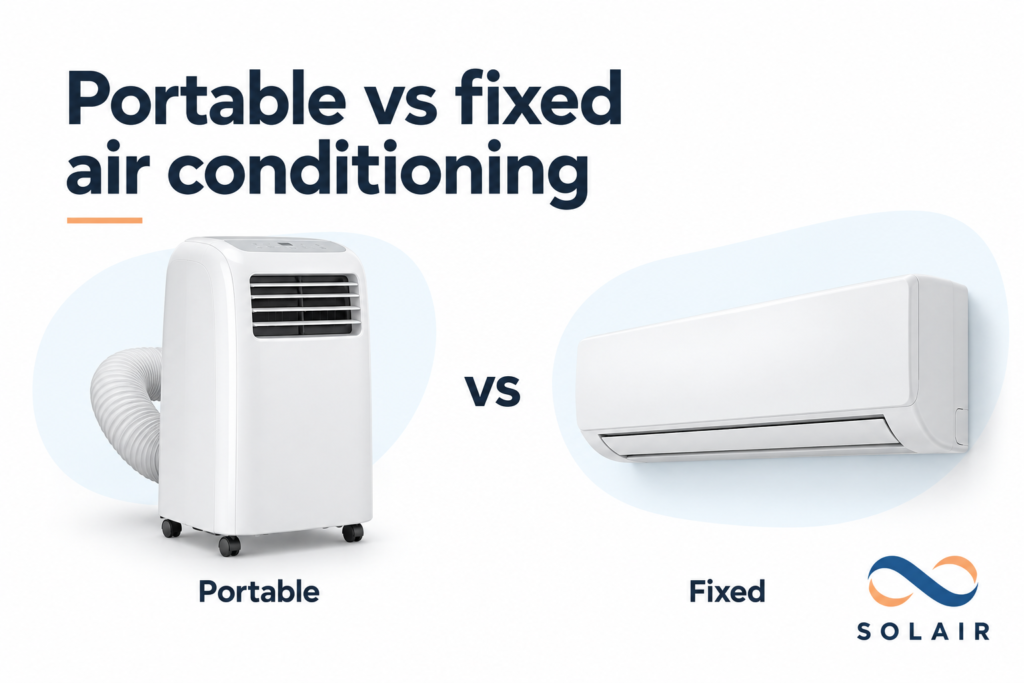
A portable air conditioner costs a few hundred pounds and needs no installer, but it is noisy, it needs a hose out of an open window, and in a real room it often delivers much less cooling than the box suggests. A fixed split system costs around £1,900 to £2,600 for one room fitted, but it is close to silent indoors, cools far more effectively for the electricity it uses and can heat the room in winter too.
If you want to cool one room for a few weeks a year, or you rent, a portable unit can make sense. If you want a room to be comfortable every summer for the next 10 to 15 years, a fixed system is almost always the better buy. Here is why.
How each one works
Every air conditioner does the same basic job. It takes heat out of the room and dumps it somewhere else. The difference is where the hot parts live.
A portable air conditioner puts everything in one box on wheels that sits in the room. It gets rid of heat through a wide hose that you push out of a window, usually with a fabric or plastic seal around it.
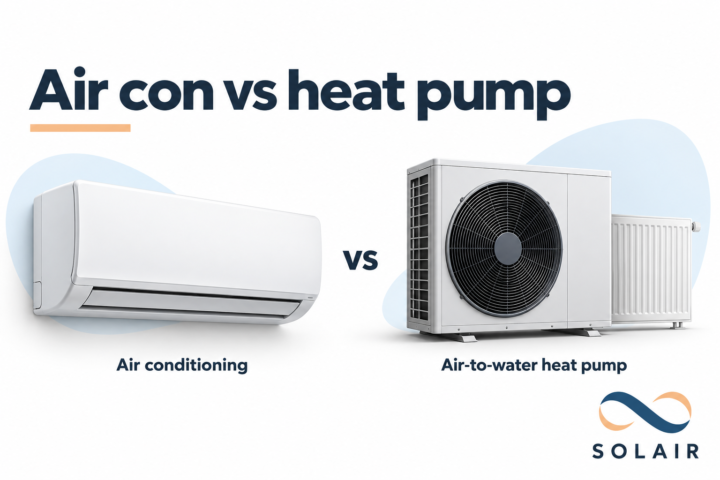
A fixed split system splits the job in two. A slim indoor unit sits high on the wall and quietly blows cool air. The noisy, hot parts (the compressor and the big fan) are in an outdoor unit outside. A small pipe and cable through the wall connects them.
That one design difference explains almost every point below.
Cooling: the box figure is not the whole story
Portable units are sold by BTU, often 9,000 or 12,000 BTU. But most portable units sold in the UK are single-hose models, and they have a built-in weakness.
A single-hose unit takes air from the room, uses it to cool its hot parts, then blows it out of the window. That air has to be replaced, so warm air from outside and from the rest of the house is drawn back in through gaps in doors and windows. The gap around the window hose lets more warm air in. The result is that the unit is partly cooling air it has just pulled in from outside.
Some industry estimates suggest a single-hose portable delivers only around half to two thirds of its rated cooling in a real room. Dual-hose models, which have a second hose to draw outside air in, do better.
A fixed split system has no hose and no open window. The room stays sealed, so the cooling you pay for stays in the room.
Noise
This is the difference people notice first.
With a portable unit, the compressor is in the room with you. Typical portable units run at somewhere around 50 to 58 dB(A) at a metre, which is like a busy office or a loud conversation. Many people find them too loud to sleep with.
With a split system, the compressor is outside. Good indoor units can run as quietly as about 19 to 25 dB(A) on their lowest setting, which is close to a whisper. Every 10 dB(A) roughly doubles how loud a sound seems, so the gap is bigger than the numbers look.
If you want air conditioning in a bedroom, this alone is usually the deciding factor.
Running costs
Portable units use more electricity for the cooling they actually deliver.
A typical 9,000 BTU portable unit draws around 1kW while the compressor is running. At the October to December 2026 price cap rate of 26.32p per kWh, that is about 26p an hour. A modern 2.5kW split system typically uses around 0.6 to 0.8kWh an hour, or about 16p to 21p an hour, and it is doing more useful cooling in that time.
Fixed units are much more efficient because they use inverter compressors that slow down once the room is cool, rather than switching fully on and off. Their seasonal efficiency ratings (SEER) are often 6 or higher, while portable units are tested on a simpler measure and typically score far lower. The two labels are not directly comparable, but the gap in real use is large.
Your own figures will depend on your tariff, the size of the room and how hot it gets. Our guide to air conditioning costs has a full worked example.
Heating in winter
Most portable air conditioners only cool. Some have a basic heating mode, but it is often no better than an electric heater.
A reversible split system is an air-to-air heat pump. It can heat a room in winter using a fraction of the electricity a plug-in heater would use, because it moves heat in from outside rather than making it. That turns air conditioning from a summer luxury into something you use all year, and it is one reason Solair only fits reversible systems.
Upfront cost
| Portable unit | Fixed split system (one room) | |
|---|---|---|
| Typical price | £300 to £650 | £1,900 to £2,600 fitted |
| Installation | None, plug in | Usually one day |
| Lifespan | Often a few summers | Commonly 10 to 15 years with servicing |
Your fixed price depends on the room, the pipe run and where the outdoor unit can go, which is why it is confirmed after a survey. Our cost guide explains what affects it.
Security, space and convenience
A portable unit needs a window open far enough for the hose. On a ground floor at night that is a security worry, and it can cause problems with home insurance if a window is left open. The unit also takes up floor space, and many models collect water that you have to empty.
A fixed system takes up no floor space, keeps your windows locked and drains condensation away through a small pipe. You control it with a remote or an app.
On the other hand, a portable unit can move from room to room, and you can take it with you when you move house.
Planning permission and permission from the landlord
A portable unit needs no permission from anyone.
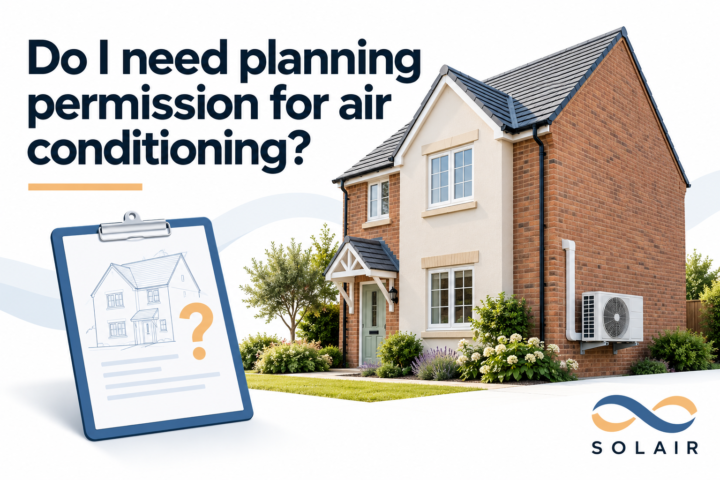
Most houses in England can fit a reversible split system under permitted development, as long as it meets the size, siting and noise rules. Flats, listed buildings and leasehold homes are more complicated, and you may need the freeholder’s consent. Our guide to planning permission for air conditioning covers the details.
When a portable unit is the right choice
We would rather tell you honestly when a portable unit makes more sense:
- You rent and your landlord will not allow a fixed system.
- You live in a flat where the freeholder or building rules do not allow an outdoor unit, and you cannot get consent.
- You only need cooling for a few hot days a year in a room you rarely use.
- You need something this week during a heatwave, while you plan a proper system.
If you go portable, a dual-hose model with a good window seal will cool much better than a single-hose unit.
When a fixed system is the better buy
- You want to sleep in a cool, quiet bedroom.
- You work from home in a room that overheats every summer.
- You want heating as well as cooling, for example in a loft conversion, extension or garden room.
- You own your home and plan to stay a few years.
Frequently asked questions
Are portable air conditioners worth it?
They can be for occasional use, especially if you rent. For a room you use every day through the summer, most people find the noise, the open window and the weaker cooling frustrating, and they end up wishing they had fitted a fixed system.
Is a portable air conditioner cheaper to run than a split system?
Usually not. A portable unit uses about the same or more electricity per hour, and it delivers less real cooling because warm air leaks back in. Over a summer a fixed system normally costs less to run for the same comfort.
Can you use a portable air conditioner without a window?
Not properly. The hot air has to go outside, so the hose needs a window, door or a vent in the wall. Units sold as “ventless” are usually evaporative coolers, which do not work well in humid UK weather.
Do I need planning permission for a split system?
Most houses in England do not, if the system can heat as well as cool and meets the permitted development rules. Flats and listed buildings are different. See our planning guide.
How long does it take to fit a fixed air conditioning unit?
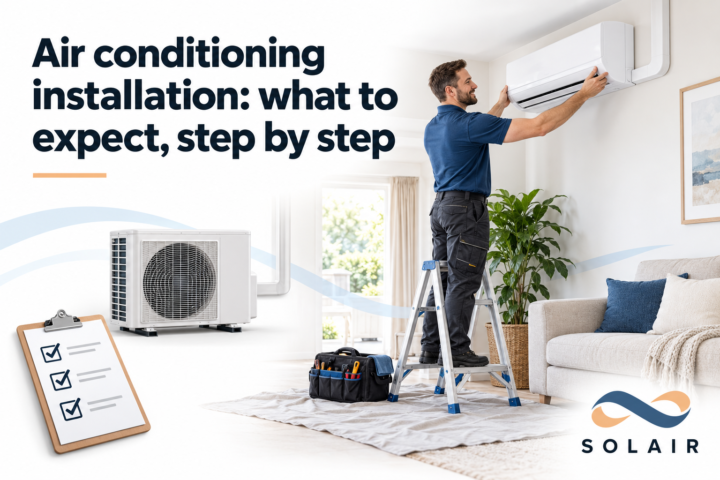
A single room is usually fitted in a day. See our guide to what happens when air conditioning is installed.
Thinking about a fixed system? Try our instant air conditioning estimate, read more about air conditioning with Solair, or request a free survey for a fixed, written price. We cover homes across Surrey, Sussex, Hampshire and London.