Most UK bedrooms and home offices need a 2.5kW air conditioning unit, a typical living room needs 3.5kW, and a large open-plan kitchen-diner usually needs 5kW or more. A good starting point is about 100 watts of cooling for every square metre of floor, then a little more for rooms that get a lot of sun, have big windows or sit in the loft.
Below is a simple chart you can use to check your own rooms, what kW and BTU actually mean, and why getting the size right matters more than most people think.
kW and BTU: what the numbers mean
Air conditioning size is the amount of heat a unit can move out of a room each hour. In the UK it is usually given in kilowatts (kW). American and portable units often use British Thermal Units (BTU) instead.
The conversion is simple: 1kW is about 3,412 BTU per hour. So:
- 2.0kW is about 7,000 BTU
- 2.5kW is about 9,000 BTU
- 3.5kW is about 12,000 BTU
- 5.0kW is about 17,000 BTU
- 7.0kW is about 24,000 BTU
One point that catches people out: the kW figure is the cooling output, not the electricity the unit uses. A modern 2.5kW wall unit moves 2.5kW of heat while drawing only a fraction of that from the socket, which is why running costs are lower than people expect. Our guide to air conditioning costs covers what that means on your bill.
Room size chart
Fixed wall-mounted units come in a handful of standard sizes, most often 2.0, 2.5, 3.5, 5.0 and 7.0kW. Here is a guide to which one fits a typical room with average insulation and normal ceiling height.
| Floor area | Typical room | Suggested size | Roughly in BTU |
|---|---|---|---|
| Up to 15m² | Small bedroom, nursery, box room office | 2.0kW to 2.5kW | 7,000 to 9,000 |
| 15m² to 25m² | Double bedroom, home office | 2.5kW | 9,000 |
| 25m² to 35m² | Main bedroom, small living room | 3.5kW | 12,000 |
| 35m² to 50m² | Living room, dining room | 5.0kW | 17,000 |
| 50m² to 70m² | Open-plan kitchen-diner, large extension | 6.0kW to 7.0kW | 20,000 to 24,000 |
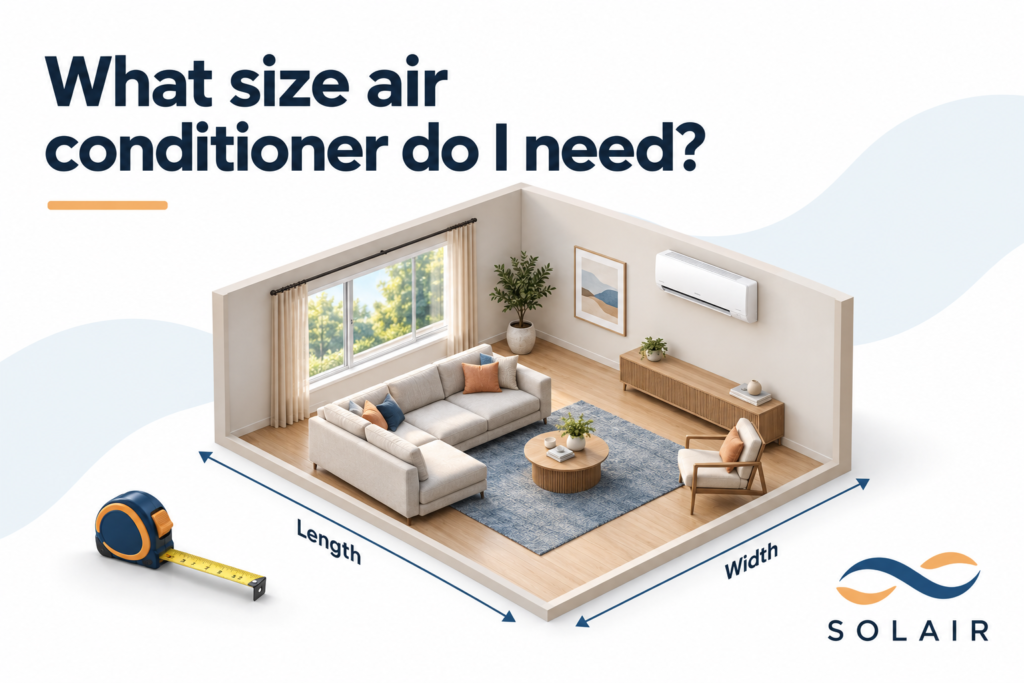
To measure floor area, multiply the length of the room by its width in metres. A bedroom 4m by 3.5m is 14m², so a 2.0kW or 2.5kW unit would normally do.
Five things that push the size up
The chart assumes an ordinary room. These are the things that mean you need a bigger unit than the floor area alone suggests.
Sun and glass. A south or west-facing room with big windows, bifold doors or a roof lantern can need 10% to 15% more cooling. Glass lets heat in fast on a summer afternoon.
Loft rooms and top floors. Rooms in the roof heat up much more than rooms lower down, especially if the loft conversion is older and less well insulated. These rooms often need to move up a size.
High ceilings. The chart assumes a ceiling of about 2.4m. Victorian and Edwardian houses across Surrey, Sussex and London often have taller ceilings, which means more air to cool. Add roughly 10% for each extra metre of height.
Kitchens and busy rooms. Ovens, hobs, fridges, computers and people all give off heat. A kitchen-diner or a home office with several screens needs more cooling than a bedroom of the same size.
Poor insulation. Single glazing, draughty doors and thin walls let heat back in as fast as the unit takes it out. If your home is older or less well insulated, size up.
As a rough worked example, a 20m² home office on the top floor with a south-facing window starts at about 2.0kW (20m² x 100W). Add 15% for the sun and something for the computer equipment and the loft position, and you are close to 2.5kW to 3.0kW. In practice that would mean a 3.5kW unit running gently, or a 2.5kW unit working harder on the hottest days. A surveyor would decide between them after looking at the room.
Why size matters
It is tempting to think bigger is safer. It is not.
Too small and the unit runs flat out on hot days and still struggles to reach the temperature you set. It uses more electricity than it should and wears faster.
Too big and the unit cools the room very quickly, then switches off, then on again. This is called short cycling. It wastes energy, it wears the compressor, and it is worse at taking moisture out of the air, so the room can feel cold and clammy rather than comfortable. A bigger unit also costs more to buy.
Modern inverter units are better at this than older on/off models, because they can slow down rather than stop. But a well-matched unit is still quieter, cheaper to run and more comfortable.
Sizing for heating as well as cooling
Every system Solair fits is reversible, which means it can heat a room in winter as well as cool it in summer. Most units give slightly more heating output than cooling output, so a unit sized for summer cooling will usually heat the same room well in spring and autumn.
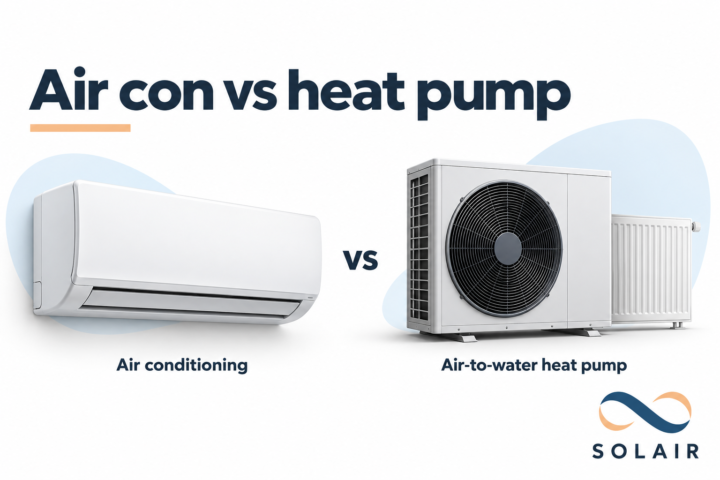
If you want a unit to be the main heating for a room through a cold winter, the sizing needs a bit more care. The heat loss of the room on a freezing day matters as much as the summer heat gain. This is something we check on survey. Our guide to air conditioning vs heat pumps explains how reversible air conditioning works as heating.
Sizing several rooms on one system
If you want air conditioning in two or more rooms, a multi-split system lets several indoor units share one outdoor unit. Each indoor unit is still sized for its own room using the chart above. The outdoor unit is then chosen to match the indoor units connected to it, allowing for the fact that rooms rarely all need full power at the same moment.
For example, two bedrooms at 2.5kW each and a living room at 3.5kW could run from a single outdoor unit of around 7kW to 8kW, depending on the brand.
What about portable units?
Portable air conditioners are usually sold in BTU, often 9,000 or 12,000 BTU. Their real-world cooling tends to fall short of the figure on the box, because the hot air hose sits in a gap in the window and warm air leaks back in. If you are comparing a portable unit with a fixed system, a fixed unit with the same rating will usually cool the room noticeably better. Our guide to portable vs fixed air conditioning goes into this in detail.
Frequently asked questions
What size air conditioner do I need for a bedroom?
Most double bedrooms in the UK need a 2.5kW (about 9,000 BTU) unit. A small single bedroom or nursery may only need 2.0kW, and a large main bedroom with an en suite or a lot of glass may need 3.5kW.
How many BTU do I need for a 20m² room?
About 7,000 to 9,000 BTU, which is a 2.0kW to 2.5kW unit. If the room gets strong afternoon sun or is in the loft, go towards the top of that range or the next size up.
Is a 2.5kW air conditioner enough for a living room?
It is enough for a small living room of up to about 25m². Most living rooms are larger than that, and a 3.5kW unit is the usual choice.
Can one air conditioning unit cool a whole house?
Not usually. A wall-mounted unit cools the room it is in and a little of the space next to it, but it will not push cool air through closed doors into other rooms. If you want several rooms covered, a multi-split system with one indoor unit per room is the normal answer.
Is it better to oversize an air conditioner?
No. An oversized unit costs more to buy, switches on and off more often, and is worse at removing humidity. A unit that is matched to the room is more comfortable and cheaper to run.
Do I need a survey to choose the size?
Our chart will get you close, and our instant estimate gives a price based on how many rooms you want and whether they are standard or large. But a survey looks at the things a chart cannot see, such as glazing, insulation, which way the room faces and where the outdoor unit can go. That is why Solair gives a fixed, written price only after a free survey.
Want to see what your rooms need? Try our instant air conditioning estimate, read more about air conditioning with Solair, or request a free survey. We cover homes across Surrey, Sussex, Hampshire and London.